
Physical therapy after a car accident in Maryland can support recovery, address pain and mobility issues, and provide documentation of your treatment following the crash. Every year, Maryland sees over 100,000 police-reported vehicle crashes, according to the Maryland Department of Transportation. These accidents send tens of thousands of drivers and passengers to emergency rooms with injuries that range from mild sprains to life-altering trauma. At Innovative Healthcare Centers, we treat patients recovering from motor vehicle accidents (MVAs) across our 11 Maryland locations, and we see the same pattern again and again: the people who start physical therapy within days or weeks of their crash get back to normal faster, with fewer long-term complications, than those who wait.
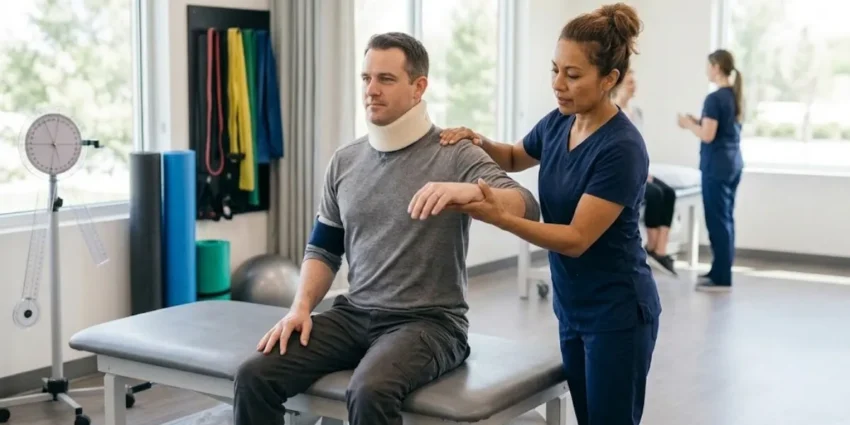
What Are the Most Common Injuries from Maryland Car Accidents?
Whiplash is a common injury after motor vehicle accidents. The sudden acceleration-deceleration forces of a rear-end collision whip the head backward and then forward, straining the soft tissues of the cervical spine. The APTA’s clinical practice guideline on neck pain notes that up to 50% of people with whiplash-associated disorders still report neck pain a year later when they do not receive timely treatment. Beyond whiplash, physical therapists at Innovative Healthcare Centers routinely treat these post-MVA conditions:
- Low back pain and lumbar strain. Even at low speeds, the force transmitted through the seat can compress and twist the spine, leading to back pain that lasts weeks or months.
- Shoulder injuries. Bracing against the steering wheel or dashboard can tear the rotator cuff or labrum, often producing pain that does not fully register until the adrenaline of the crash fades.
- Knee injuries. Dashboard impact in frontal collisions commonly damages the patella, ligaments, or meniscus.
- Head injuries and concussion. A strike against the window, headrest, or airbag can produce a traumatic brain injury, even without loss of consciousness.
- Nerve damage. Herniated discs, spinal misalignment, or direct blunt trauma can compress or stretch nerves, producing numbness, tingling, or weakness in the arms and legs. Our clinic performs EMG/NCS testing to quantify nerve function and guide treatment.
One mistake we see often is a patient who feels “mostly fine” in the first 48 hours and decides to skip medical care. Pain and inflammation may become more noticeable in the hours or days after a crash. Pain that seems minor at the scene can intensify dramatically days later. Getting evaluated promptly does more than just address the injury early: it also creates a medical record that links your symptoms to the crash, which matters for both your health and any future claim.
Why Does Early Physical Therapy Matter After an Auto Accident?
The days immediately following a car crash set the trajectory for your recovery. When you start PT early, several things happen that are harder to achieve once scar tissue and compensation patterns set in. Manual therapy and gentle movement keep muscles and joints from stiffening into a protective guarding pattern. Guided exercise re-establishes normal movement before your brain “learns” faulty compensation strategies, like limping or hunching one shoulder. Pain neuroscience education, a component of modern PT, reduces fear of movement, which is one of the strongest predictors of chronic pain after a whiplash injury.
Research on whiplash-associated disorders supports early, active treatment. The APTA’s clinical practice guideline recommends active exercise and manual therapy within the first few weeks after injury, noting that prolonged rest and immobilization with a soft collar can delay recovery. The contrast matters: the old advice was “rest until it stops hurting.” The evidence now says “move carefully, guided by a physical therapist, as soon as it is safe.”
There is also a practical side to early intervention that affects your insurance claim. A gap of weeks or months between the crash date and your first physical therapy visit creates a window where the insurance adjuster can argue that something other than the accident caused your pain. Starting treatment quickly builds a timeline that connects the crash to the injury and the injury to the recovery plan.
What Physical Therapy Treatments Are Used After a Car Accident?
No two MVA injuries are identical, so your physical therapist designs a treatment plan around your specific findings from the initial evaluation. That evaluation typically includes a detailed history of the crash, a movement and strength assessment, palpation of painful areas, and, when nerve injury is suspected, a referral for in-house EMG/NCS testing at Innovative Healthcare Centers. From there, the plan draws from a combination of these evidence-based approaches:
| Treatment | What It Involves | Best For |
|---|---|---|
| Manual therapy | Hands-on joint mobilization, soft tissue massage, and myofascial release performed by your PT | Neck stiffness, restricted spinal mobility, muscle guarding after whiplash |
| Therapeutic exercise | Graduated strengthening, range-of-motion work, and postural retraining tailored to your injury | Restoring neck, shoulder, and back function; preventing chronic weakness and compensation |
| Dry needling | Fine, sterile needles placed into trigger points to release tight muscle bands | Persistent muscle knots in the neck, upper back, and shoulders that do not release with manual therapy alone |
| Modalities (heat, ice, TENS, ultrasound) | Adjunct tools to manage pain and inflammation so you can tolerate active treatment | Acute pain in the first 1-2 weeks, used alongside exercise rather than as a standalone treatment |
| Vestibular therapy | Exercises to retrain balance, gaze stability, and spatial orientation | Dizziness, vertigo, or balance problems after concussion or inner ear trauma from the crash |
| EMG/NCS testing | Nerve conduction studies and electromyography to measure how well nerves and muscles are functioning | Numbness, tingling, weakness, or suspected radiculopathy radiating into the arms or legs |
The goal is not just to reduce pain but to restore the movement patterns and strength you need for daily life, whether that means turning your head to check a blind spot without wincing, lifting a child, or returning to a physically demanding job.
How Does Maryland Auto Insurance Cover Physical Therapy?
Maryland auto insurers are generally required to offer at least $2,500 in Personal Injury Protection (PIP) coverage. PIP can help pay reasonable and necessary medical expenses after a car accident, including physical therapy, regardless of who caused the crash. However, Maryland allows certain policyholders to waive or limit PIP coverage, so the amount available depends on the individual policy.
If you have PIP coverage, it may help pay your physical therapy bills up to your policy limit. Depending on your coverage, additional MedPay benefits or health insurance may also help cover treatment after PIP benefits are exhausted. How these benefits work together can vary based on your auto policy, health insurance plan, and the circumstances of your claim.
If you are pursuing a claim against an at-fault driver, medical expenses related to your physical therapy may also become part of the overall claim. An attorney or insurance professional can explain how those expenses may be handled in your specific situation.
The Maryland Insurance Administration is a helpful resource for understanding PIP and other auto insurance coverage in Maryland. Before starting treatment, review your auto policy’s PIP and MedPay information or contact your insurer to confirm what coverage you have. Innovative Healthcare Centers can also help verify available auto insurance benefits before treatment begins.
Should I Work with an Attorney After a Maryland Car Accident?
This is not a question a physical therapy practice can answer for you; it is a personal decision based on the circumstances of your crash, your injuries, and your comfort navigating the insurance system alone. What we can tell you from experience is that many of our MVA patients do work with a personal injury attorney, and the attorney-clinic relationship matters for the quality and speed of your care.
Innovative Healthcare Centers has a dedicated attorney line at 410-844-3252 and an MVA/Legal Team that coordinates directly with law firms on medical records, billing under liens or letters of protection, progress reporting, and scheduling. When your attorney and your physical therapist communicate directly, there is less back-and-forth for you to manage, and your treatment plan stays aligned with the documentation needs of your claim. Our team can also provide the objective diagnostic data, including EMG/NCS reports, that attorneys rely on to substantiate injury severity.
A reminder: nothing in this article constitutes legal advice. The decision to hire an attorney, and which one to hire, should be your own. We work with many respected Maryland firms and are happy to point you toward our attorney resource page for general information, but we do not recommend specific counsel.
What Should I Ask at My First Physical Therapy Appointment After an MVA?
Your first visit is your best opportunity to align your recovery goals with the clinic’s approach and to understand how the billing and documentation side will work. Here are the questions we recommend every MVA patient ask:
- “Do you accept auto insurance and bill PIP directly?” The answer should be yes. You should not have to pay out of pocket and seek reimbursement yourself.
- “Do you have experience communicating with personal injury attorneys?” If an attorney is involved, your PT clinic needs to produce the right documentation, in the right format, on the right timeline.
- “What does my initial evaluation include?” You should hear a clear description: history of the crash, range of motion testing, strength assessment, palpation, and any special tests relevant to your complaints.
- “How often will I be seen, and for how long?” A typical MVA plan may start at 2 to 3 visits per week for 6 to 12 weeks, depending on severity, but your PT should give you a projected timeline at the first visit.
- “Will I need diagnostic testing like X-rays, MRI, or EMG/NCS?” Your PT can tell you whether your symptoms warrant imaging or nerve testing. At Innovative Healthcare Centers, we offer EMG/NCS testing on-site, allowing patients to access nerve testing within the same care network when it is clinically appropriate.
- “What can I do at home between sessions?” A good PT gives you a home exercise program from day one, because the work you do between visits often determines how fast you progress.
What Red Flags Should I Watch For After a Car Accident?
Most MVA injuries respond well to conservative care, but some symptoms should prompt immediate medical attention rather than waiting for a PT appointment. Go to the emergency room if you experience any of the following in the hours or days after a crash:
- Loss of consciousness at any point, even briefly
- Severe or worsening headache, especially with nausea or vomiting
- Numbness, tingling, or weakness in both arms, both legs, or on one entire side of the body
- Difficulty speaking, confusion, or unusual drowsiness
- Severe neck pain with stiffness that prevents you from touching your chin to your chest
- Seizure or convulsion
Once a physician has cleared you of these emergency conditions, physical therapy can address the musculoskeletal injuries that remain.
How Long Does Recovery Take After a Maryland Car Accident?
Recovery timelines vary significantly. A mild whiplash strain treated early may resolve in 4 to 6 weeks. A moderate case with referred arm pain or headache may take 8 to 12 weeks of consistent PT. Injuries involving herniated discs, nerve damage confirmed on EMG/NCS, or concurrent concussion can extend recovery to 4 to 6 months or longer. The single most important variable under your control is adherence: the patients who attend their scheduled sessions and do their home exercises consistently recover faster, period.
Frequently Asked Questions
Do I need a doctor’s referral for physical therapy after a car accident in Maryland?
Maryland is a direct-access state for physical therapy, which means you can see a physical therapist without a physician’s referral for an initial evaluation and treatment. However, your auto insurance carrier may require a referral or prescription to authorize ongoing visits. Check your policy or ask our front desk to verify your benefits before your first appointment.
What if my PIP coverage runs out before I finish PT?
If your PIP limit is reached and you still need treatment, your health insurance may step in as a secondary payor. If you are working with an attorney, many clinics, including Innovative Healthcare Centers, can also treat under a letter of protection or attorney lien, which defers payment until your case settles. Discuss these options with your attorney and our billing team.
Does physical therapy help with the legal side of my accident claim?
Physical therapy generates the medical documentation that your attorney uses to substantiate your injuries: evaluation findings, treatment notes, progress reports, and any diagnostic test results like EMG/NCS. Consistent attendance and documented functional improvement strengthen your claim. Missed appointments, large gaps in care, or stopping treatment against your PT’s advice can weaken it. Your PT treats your body; your attorney handles your case. The two work in parallel, but the quality of one affects the other.
Can physical therapy help with anxiety or PTSD after a car accident?
Physical therapy is not a treatment for psychological trauma. However, many patients report that the structured, supportive environment of PT, combined with progressive physical improvement, helps reduce the driving anxiety and hypervigilance that often follow a serious crash. If you are struggling with flashbacks, panic, or avoidance after your accident, please tell your PT or your primary care physician so they can connect you with a qualified mental health professional.
How does Innovative Healthcare Centers handle MVA patients differently?
We have a dedicated MVA/Legal Team that understands Maryland PIP billing, attorney communication, and the documentation standards that personal injury cases require. We offer in-house EMG/NCS testing to objectively assess nerve and muscle function, helping patients access diagnostic testing within the same care network when clinically appropriate. Our attorney line at 410-844-3252 gives law firms a direct channel to coordinate care. And with 11 Maryland locations, we can usually offer an appointment within 24 to 48 hours of your call, which matters when early intervention is the goal.
Start Your Recovery Today
If you have been injured in a car accident in Maryland, do not wait for the pain to get worse before seeking help. The first step is an evaluation with a physical therapist who understands MVA injuries and Maryland’s auto insurance system. Schedule your appointment at any of our 11 Maryland locations, or call us directly to verify your auto insurance benefits before your first visit. If you are working with an attorney, have them contact our dedicated MVA line at 410-844-3252 to coordinate your care from day one.